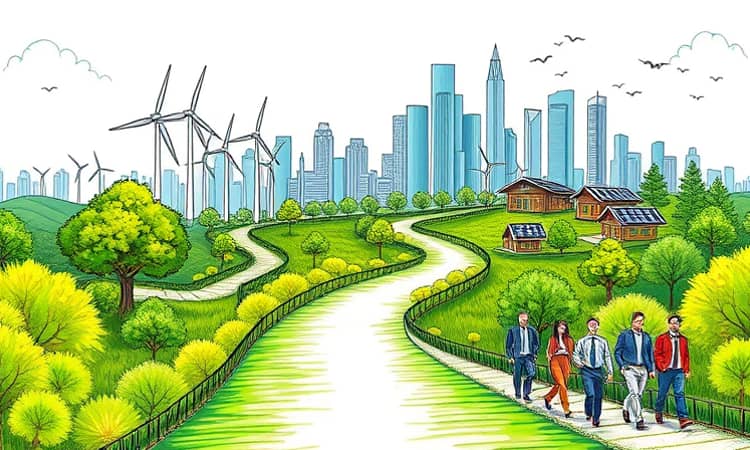
In an era defined by climate imperatives and economic uncertainty, sustainable debt markets are evolving rapidly. From green bonds to performance-linked loans, financial institutions, governments, and corporations are refashioning capital flows to align profit with purpose. This article explores how carefully structured lending can not only finance the transition to a low-carbon future but also deliver stable growth, mitigate risk, and foster social inclusion.
Big-Picture Context: Why Loans for Sustainable Prosperity
Global sustainable debt volumes soared to roughly $1.5 trillion in 2024 before dipping by around 20% to $1.2 trillion in the first nine months of 2025. ING projects a slight decline to $1.539 trillion for the full year 2025, followed by a rebound to $1.621 trillion in 2026. Within that pool, green bonds and loans remain the growth engines, with forecasts of $700 billion in green bonds and $255 billion in green loans issuance in 2026.
Why does this matter? The twin goals of financing climate mitigation and adaptation and fortifying digital and physical infrastructure require trillions in investment annually—particularly in emerging economies. Yet, over-leveraging without proper safeguards risks saddling communities with unsustainable debt burdens. Prudence means structuring finance to close investment gaps while controlling exposure to stranded assets, policy shifts, and market volatility.
Green Loans: Steering Capital Toward Climate Solutions
Green loans, governed by Green Loan Principles (GLP), earmark proceeds exclusively for environmentally beneficial projects—renewable energy, energy efficiency, clean transport, water management, and pollution prevention. By January–September 2025, green loans comprised roughly one-third of the labelled loan market by volume, and issuance is expected to reach $255 billion in 2026.
- Clear project eligibility criteria prevent misallocation.
- Transparent impact reporting tracks real-world outcomes.
- Third-party verification reduces greenwashing risk among borrowers.
This structure builds trust among lenders and regulators. In fact, companies financing green projects under similar bond frameworks have demonstrated sustained emissions reductions, underlining how clear use of proceeds translates into tangible environmental benefits.
Sustainability-Linked Loans: Incentivizing Corporate Change
Sustainability-linked loans (SLLs) tie pricing and other terms to borrowers’ performance on pre-agreed key performance indicators (KPIs) and sustainability performance targets (SPTs). Common metrics include greenhouse gas intensity, renewable energy share, workplace diversity, and safety improvements. By volume, SLLs account for about 40% of labelled loans, with issuance set to rise from $139 billion in 2025 to $160 billion in 2026.
- They enable firms without large green capex projects to access sustainable finance.
- Pricing adjustments reward or penalize environmental or social performance.
- Borrowers are encouraged to drive broad operational changes across their value chains.
However, critics warn that weak KPIs and modest financial penalties can dilute impact. Regulators and investors now demand rigorous reporting and transparency standards, more ambitious targets, and meaningful pricing step-ups and step-downs to ensure that these loans deliver on their promise.
Other Sustainable Loan Categories
Beyond green and performance-linked products, the sustainable loan universe includes social loans, transition loans, and mixed-use frameworks:
- Social loans: financing for affordable housing, healthcare, education, and SME inclusion.
- Transition loans: funding credible pathways for hard-to-abate sectors to decarbonize.
- Mixed environmental and social loans: supporting projects that generate both climate and community benefits.
Transition finance frameworks, particularly in Asia, channel capital into activities that are not yet fully green but align with science-based decarbonization pathways. ING notes that transition debt issuance will be highly concentrated in the APAC region as national frameworks gain traction in China, India, and beyond.
Market Dynamics: Contraction, Rebound, and Regional Trends
After peaking at $1.668 trillion in 2024, sustainable debt issuance fell to $1.539 trillion in 2025—mirroring a 20% contraction in labelled market volumes. Political uncertainties, less supportive policies, and higher funding costs drove caution among issuers and lenders. Yet, forecasts point to a rebound in 2026, underscoring the resilience of sustainability-linked finance.
Regionally, non-financial corporate issuance fell by 15.3% in 2025 but is set to climb 10% in 2026. EMEA leads volumes, with green loans rising even as sustainability-linked loans slump. The US market remains stable in the $90–100 billion range, while APAC is poised for double-digit growth, driven by renewable infrastructure and grid modernization needs.
Balancing Opportunity and Risk: Embracing Prudence for Lasting Impact
While sustainable lending unlocks vast potential for climate action and social progress, it is not immune to macroeconomic cycles, policy shifts, or structural vulnerabilities. To navigate this landscape responsibly, lenders and borrowers must adopt robust risk assessment frameworks that integrate:
- Forward-looking policy and regulatory analysis.
- Technology cost curve projections and transition scenarios.
- Impact measurement aligned with global standards.
- Material, science-based targets and credible verification.
By embedding prudence at every stage—from project selection to pricing, monitoring, and reporting—financial institutions can steward capital that delivers both long-term prosperity and resilience. Ultimately, the prudent path is not about dialing back ambition; it is about ensuring that our collective journey toward sustainability is financially sound, socially inclusive, and environmentally transformative.