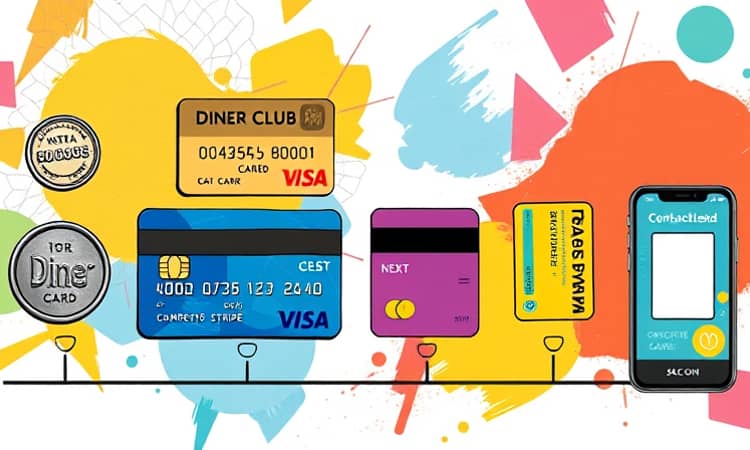
From simple metal charge coins to today’s biometric-enabled digital wallets, credit cards have revolutionized commerce and personal finance over the last century and a half. In this article, we trace the journey from early retailer tokens to the latest tokenization methods, exploring the innovations and regulations that shaped modern payment systems. Whether you’re a seasoned consumer or a new cardholder, understanding this history empowers you with practical knowledge to navigate current trends and anticipate future developments.
Pre-Modern Roots: Charge Coins, Plates, and Early Market Cards
The concept of deferred payment can be traced back to the 1860s when retailers issued metal or celluloid charge coins engraved with account numbers. By 1914, Western Union introduced metal charge plates stamped with customer IDs as an alternative. While functional, these devices were retailer-specific, requiring merchants to maintain ledgers correlating coins to accounts.
During the 1930s, department stores across the United States began offering proprietary charge tokens, laying the cultural groundwork for broader credit acceptance. Air Transport Association’s launch of the Air Travel Card in 1934, followed by Charg-It in 1946, showcased early attempts at multi-merchant payment networks. These developments introduced deferred payment structures that revolutionized retail, setting the stage for universal cards.
The 1950s: Diners Club, American Express, and Bank-Issued Revolving Credit
In 1950, Diners Club issued the first modern credit card, enabling cardholders to consolidate restaurant and entertainment expenses into a single monthly statement. Initially made of heavy cardboard, the Diners Club card established a centralized billing process that consumers quickly embraced.
American Express debuted its purple cardboard charge card in 1958 and transitioned to durable PVC plastic in 1959. That same year, Bank of America rolled out BankAmericard with a 25-day grace period and installment payment options. These products marked the birth of mass-market credit tools, reshaping consumer spending patterns and financial services.
1960s–1970s: Banking Alliances, Magnetic Stripes, and Consumer Protections
The success of early plastic cards spurred banks to form networks. In 1966, a consortium of California banks created the Interbank Card Association, marketing Master Charge to compete with BankAmericard. These alliances granted cardholders access to a wider merchant base and pooled resources for processing and risk management.
IBM engineer Forrest Parry’s invention of magnetic stripe technology in 1969 revolutionized data storage on cards. By encoding account information on a magnetic band, transactions became faster, more accurate and less prone to manual errors. This innovation established a global standard for decades and accelerated the industry’s expansion.
1980s–1990s: Rewards, Security Chips, and the Rise of E-Commerce
As competition intensified, issuers turned to loyalty programs to differentiate their offerings. Diners Club launched Club Rewards in 1984 while Discover introduced cash-back incentives in 1986. These early programs transformed credit cards into lifestyle tools, rewarding frequent use and building customer loyalty.
Security advances kept pace with usage. Europay, Mastercard and Visa collaborated in 1994 to develop EMV chips, embedding microprocessors that generated encrypted, one-time security codes for each transaction. Alongside the introduction of CVV codes for online purchases, these measures underpinned the explosive growth of e-commerce and reduced fraud risks significantly.
2000s–2010s: Contactless Convenience, Mobile Integration, and Customization
The early 2000s saw the emergence of contactless cards using RFID and NFC, offering users faster, touch-free transactions at transit gates, restaurants and retail checkouts. Major networks adopted this technology by 2004, and pilot programs in South Korea had begun years earlier.
The smartphone revolution ushered in mobile wallets like Apple Pay and Google Pay around 2008–2011. By tokenizing payment credentials—replacing real card numbers with randomized tokens—mobile wallets balanced convenience and security. Issuers such as Capital One and Barclays offered personalized card designs and holographic features to appeal to a new generation of tech-savvy consumers.
Embracing the Future: Tokenization, Biometrics, and Beyond
Today, tokenization stands at the forefront of payment security. Whether in physical point-of-sale systems or digital wallets, tokenization ensures intercepted data cannot be used for fraudulent charges. Innovations in machine learning and real-time fraud monitoring further bolster defenses against emerging threats.
Biometric authentication—using fingerprint, facial recognition or palm vein scanning—provides seamless authentication without traditional PINs. As these methods become more widespread at ATMs and mobile apps, they promise to enhance both security and user experience. Meanwhile, blockchain-based payment solutions and cryptocurrency-linked cards hint at a future of decentralized finance and expanded payment choices.
Key Technologies and Their Impact
Major Networks and Issuers
- Diners Club: Multi-merchant pioneer since 1950
- American Express: Charge cards and premium rewards
- Visa (BankAmericard): First revolving credit card
- Mastercard (Master Charge): Collaborative interbank network
- Discover: Cash-back strategies since 1986
Practical Tips for Modern Cardholders
Understanding the evolution of cards helps you choose and manage payment products wisely. Here are actionable steps to maximize benefits and minimize risks:
- Compare cards based on fees, interest rates and rewards
- Set up real-time alerts to monitor transactions closely
- Use mobile wallets for tokenized transactions
- Review credit reports annually and dispute inaccuracies
- Enroll in biometric authentication where available
Looking Ahead
As we move toward open banking and decentralized finance, credit cards will continue to adapt—integrating new security protocols, offering dynamic credit limits, and possibly leveraging digital identity frameworks. Consumers who stay informed and proactive can harness these innovations to achieve financial flexibility and security.
The story of credit cards is one of relentless innovation, driven by the pursuit of speed, security and convenience. By appreciating this history, today’s users can anticipate future shifts and make empowered decisions in an ever-evolving financial ecosystem.