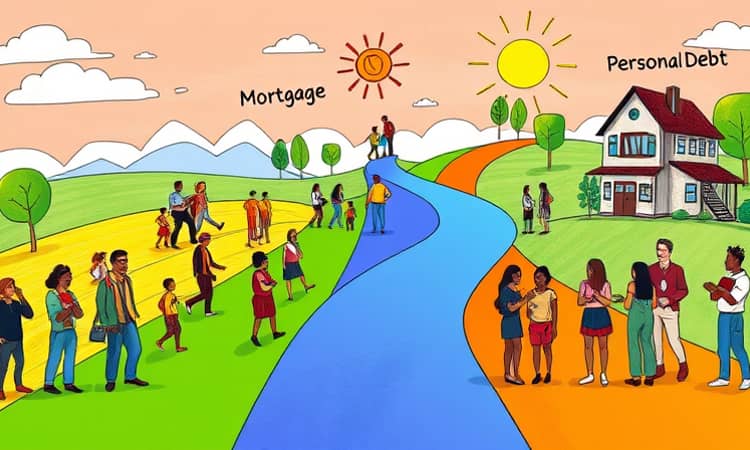
Choosing the right loan can shape your financial journey. A well-selected mortgage, student, or personal loan not only funds your goals but also protects cash flow, builds equity, and enables wealth growth. Conversely, poor decisions can lead to increased costs and ongoing stress, costing you tens of thousands in savings over time.
Understanding the Impact of Loan Choices
Every loan carries its own set of terms, interest rates, and repayment structures. In 2026, the stakes are higher as economic shifts bring new programs and end certain federal benefits. By recognizing how different products align with your credit profile, income, and life plans, you can turn debt into a stepping stone rather than a burden.
Consider Emily, who chose a conventional mortgage with only 5% down. Over 30 years, she saved nearly $50,000 in insurance premiums compared to an FHA loan by reaching 20% equity quickly. John, a recent graduate, elected an income-driven student plan and trimmed his payments to 10% of discretionary income, leveraging forgiveness after 20 years to pursue entrepreneurial ventures without crippling monthly bills.
Such examples highlight how tailored strategies—aligned with clear goals—can optimize short-term budgets and facilitate long-term wealth accumulation.
Comparing Mortgage Loan Types for 2026
In today’s housing market, down-payment requirements and lending eligibility continue to shift. To navigate these options, consider the balance between initial costs and future benefits. Many buyers will gravitate toward low-down-payment options amid high-cost areas to secure homeownership without depleting emergency reserves.
The following table outlines key features, eligibility criteria, and situational best uses for each major mortgage type in 2026.
Use FHA, VA, or USDA when savings are limited. Opt for conventional when credit exceeds 680 to minimize insurance costs. Choose jumbo or non-QM if you earn substantially or have nontraditional income streams.
Student Loan Repayment Strategies and 2026 Updates
For many borrowers, student loan debt represents the largest non-mortgage liability. The federal overhaul effective July 2026 will transform eligibility and plan structures. While standard, graduated, and extended plans are sunset for new direct loans, all borrowers will still have access to a refreshed standard option and robust income-based plans. These changes aim to simplify choices and emphasize affordability.
An updated PAYE plan will cap payments at 10% of discretionary income and include a new interest benefit to prevent balances from ballooning. The SAVE plan will replace existing IBR, offering robust income-driven repayment plans with forgiving any residual balance after 20 years for undergraduates and 25 years for graduate loans.
- New Standard Option: Ten-year term with guaranteed equal payments for all loan types.
- Revised Income-Driven: PAYE and SAVE streamline documentation and cap rates.
- Private Loan Refinancing: Banks, credit unions, and fintech platforms provide competitive fixed and variable rates for creditworthy applicants.
Implement these tactics:
- Automate payments and capitalize on lender perks such as rate reductions.
- Make lump-sum contributions when income fluctuates to reduce principal swiftly.
- Explore employer repayment assistance programs and tax benefits where available.
By combining these tools, graduates and students can navigate the changing federal environment while maintaining momentum toward debt freedom.
Personal Loans: Accelerating Debt Freedom
With personal loans, interest rates can vary widely based on credit score, term length, and lender type. Before committing, compare offers from traditional banks, online marketplaces, and credit unions. Use spreadsheets to weigh origination fees against potential interest savings. In many cases, a 7% personal loan with a one-time 3% fee can still outperform a 20% credit card balance over a two-year period.
Combining these options with debt snowball and debt avalanche methods allows borrowers to minimize costs and maximize payoff speed. For instance, Sarah refinanced her consolidated debt at a lower rate and applied her tax refund as a lump-sum payment. This single action reduced her term by six months and saved over $1,200 in interest.
- Schedule biweekly or monthly rounding payments to shave months off terms.
- Rebalance to shorter terms when credit improves to lower rates.
- Channel windfalls like bonuses directly to principal balances.
- Track progress visually to maintain motivation and clarity.
Pair personal loans with a disciplined budget that protects your emergency fund while avoiding unnecessary new debt.
Adapting to 2026’s Financial Landscape
The economic climate in 2026 rewards agility. Remote work trends and the gig economy have given rise to flexible nontraditional lending avenues that cater to freelancers, real estate investors, and small business owners. Asset-based mortgages and portfolio loans allow lenders to assess overall financial health rather than rigid paycheck documentation.
Inflation and rate volatility underscore the importance of locking in fixed rates when possible. At the same time, adjustable-rate mortgages with capped initial periods can make sense for short-term homeowners who plan to refinance or relocate in under five years. Evaluate scenarios by constructing a three- to five-year cash flow forecast, then stress-test for rate swings.
Furthermore, accessible home improvement financing—through HELOCs, renovation loans, or personal credit lines—can boost property value and personal equity when timed correctly. Balancing these variables ensures each loan complements both current needs and future plans.
Conclusion: Tailoring Loans to Your Goals
Smart loan selection is more than qualifying for the lowest rate today. It’s about crafting a path toward wealth building, stress reduction, and long-term security. Evaluate your credit profile, life plans, and market trends, then choose the mortgage, student, or personal loan that aligns with your vision.
Take the time to run multiple scenarios, seek pre-approval to clarify borrowing power, and maintain a proactive stance toward repayment strategies. By treating each debt instrument as a customizable tool, you empower your financial future. Let every monthly payment move you closer to stability, ownership, and opportunity.
In an era of rapid financial evolution, make each loan decision count as a deliberate step toward prosperity. When you align your borrowing with clear goals and disciplined action, debt transforms into a reliable partner on the road to success.