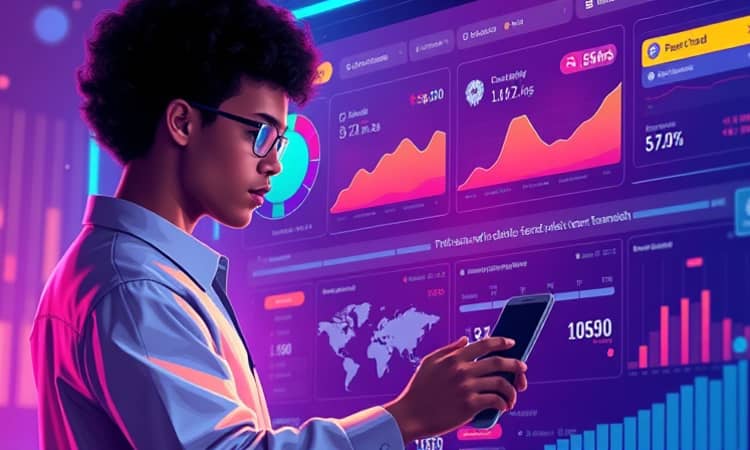
In an era defined by rapid technological advancement, financial services must evolve to meet ever-growing customer demands. By leveraging artificial intelligence and real-time data, banks and fintechs can now deliver tailored solutions that resonate with each individual’s life circumstances and aspirations.
The Definition and Core Concepts
At its essence, hyper-personalization transforms how financial products are designed, marketed, and delivered. Instead of grouping customers into broad categories, institutions aim to treat every customer as a segment of one, crafting offers, advice, and pricing that align with unique behaviors and goals.
This approach relies on a fusion of technologies and data: machine learning models analyze transactions, behavioral patterns, and contextual signals in real time, while predictive analytics forecasts life events. Omnichannel delivery—spanning mobile apps, web portals, branches, and contact centers—ensures that insights translate into timely, actionable recommendations across touchpoints.
Why Hyper-Personalized Financial Products Matter
Business leaders recognize that personalization drives measurable impact:
- Reduce acquisition costs by up to 50% through more efficient marketing and higher conversion rates.
- Lift revenues by 5–15% by aligning product offers with individual needs.
- Increase marketing-spend efficiency by 10–30% via precise targeting and timing.
Moreover, consumer expectations shaped by big-tech giants like Netflix and Amazon are pressuring banks to deliver individualized journeys. Open banking initiatives and broadened data sharing exacerbate competition, making personalization a critical differentiator and a safeguard against customer churn.
Finally, hyper-personalization fosters financial inclusion for underserved segments—from gig workers to thin-file borrowers—by leveraging alternative data sources and innovative risk models.
Transformative Use Cases Across the Financial Spectrum
Hyper-personalized offerings now span retail banking, lending, insurance, wealth management, and niche segments. Institutions deploy algorithms that react instantly to life events, spending patterns, and predicted milestones.
In retail banking, apps suggest specific accounts, cards, or loans based on recent transactions and life events. For example, a customer who just relocated and shows increased moving-related expenses might receive an optimized cash-back card offer with partner discounts at home-improvement retailers.
Personal financial management platforms integrate spending analysis and goal tracking to deliver data-driven guidance in real time. Customers receive proactive alerts when they approach budget limits, automated savings rules tuned to individual cash flow, and short-term credit options precisely matched to their repayment capacity.
On the lending front, real-time models use repayment history, income volatility, and external data feeds to pre-approve loans with personalized rates and terms. One European bank successfully targeted customers carrying competitor loans with superior refinance offers, boosting conversion rates by over 20%.
In insurance, telematics-based pay-as-you-drive policies reward safe drivers with dynamic premiums. Each trip’s score feeds into personalized pricing, ensuring customers pay truly reflective rates rather than pooled averages.
Enabling Technologies and Data Strategy
Hyper-personalization stands on a sophisticated technology stack and a diverse array of data sources. Institutions that master this stack can anticipate needs, detect life events, and deliver offers seamlessly.
- Core banking and transaction data: spend categories, merchant details, balances
- Behavioral data: app interactions, feature adoption, channel preferences
- Contextual and external data: device location, open-banking feeds, telematics
- Demographic and KYC data: age, income, household composition
Complementing these inputs is a suite of advanced tools:
- AI and Machine Learning engines for granular risk and propensity scoring
- Real-time analytics platforms to trigger offers on specific events
- Behavioral science frameworks that nudge customers toward healthier habits
- Continuous learning loops that refine models with each interaction
Benefits and Risks: A Balanced View
When done right, hyper-personalization creates a virtuous cycle of increased engagement, loyalty, and profitability. Customers feel understood and supported, leading to deeper relationships and higher cross-sell uptake. Banks benefit from more predictable revenue streams and optimized resource allocation.
However, the approach carries inherent risks. Overzealous data collection can erode trust if customers fear surveillance. Biased algorithms may inadvertently discriminate, amplifying fairness concerns. To mitigate these risks, institutions must adopt transparent data governance, robust bias-testing protocols, and clear opt-in frameworks.
Striking the right balance between personalization and privacy is essential. By adopting ethical AI guidelines and ensuring customers control their data, firms can foster trust while delivering bespoke experiences.
The Road Ahead: Future Trends
Looking forward, hyper-personalization will evolve with generative AI models capable of crafting personalized financial narratives and forecasts. Continuous, real-time feedback loops will transform static annual reviews into continuous, event-triggered micro-advice cycles that anticipate needs before they arise.
Emerging developments will include immersive financial experiences via augmented reality interfaces, deeper integration with non-financial lifestyle data, and expanded collaboration across ecosystems—where banks, retailers, and service providers co-create unified, hyper-personalized journeys.
Ultimately, institutions that embrace these innovations will not only meet customer expectations but redefine what exceptional service means in finance—anchored in empathy, precision, and adaptability.
By harnessing AI, data science, and behavioral insights responsibly, the future of financial services promises solutions that are not just for you, but uniquely of you.