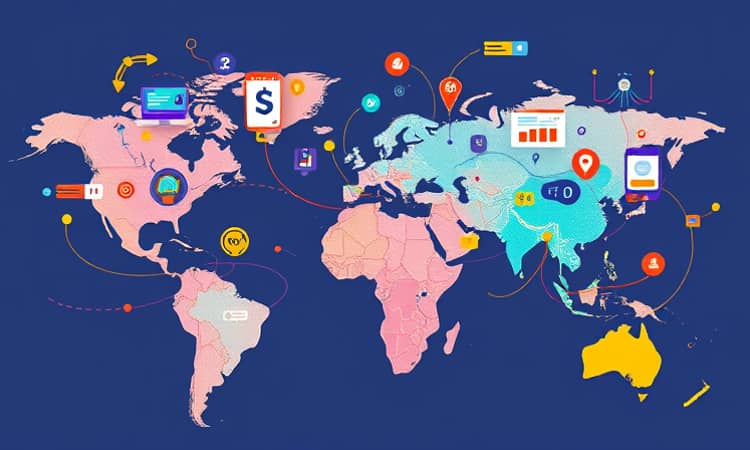
The world of finance is no longer confined to traditional banks and loan offices. It now thrives within the apps we use daily, from online shopping to business tools, reshaping how we access money and services.
This revolution, powered by FinTech's rapid global expansion, is unlocking new possibilities for financial inclusion and economic growth. By blending lending with digital platforms, it creates a seamless experience that benefits everyone.
Imagine applying for a loan while checking out on an e-commerce site, with approval in seconds. This isn't science fiction—it's the reality of today's FinTech landscape, where innovation meets practicality.
Global Growth and Market Dynamics
The FinTech sector is exploding in value and reach. Projections show it hitting $394.88 billion in 2025, with a staggering climb to $1.12 trillion by 2032.
This growth is fueled by a 16.2% compound annual growth rate, highlighting the industry's resilience and appeal. Across regions, adoption rates vary, but the trend is universally upward.
In the lending segment alone, the market is set to reach $5,679.51 million by 2033. This surge is driven by embedded models that integrate loans into other services, making finance more accessible.
Regional contributions are pivotal to this expansion. The table below summarizes key market shares and growth projections.
This data underscores the global nature of FinTech, with every continent playing a role in its evolution.
Lending Expansion to E-commerce
FinTech is blurring lines between finance and daily life. The lending-as-a-feature strategy is a game-changer, embedding loans directly into platforms like e-commerce and SaaS tools.
This approach boosts conversion rates by 70% compared to standalone products. It also slashes customer acquisition costs by 40%, making it a win-win for businesses and consumers.
Key benefits include:
- Increased sales through seamless loan integration at checkout.
- Lower barriers to credit for small businesses and individuals.
- Enhanced user experience with minimal friction.
In Latin America, this trend is evident with over 3,069 fintech companies by 2023. Lending accounts for 19% of these firms, showing its centrality to regional growth.
The shift towards business-to-business services is accelerating. B2B fintech revenues could hit USD 285 billion annually, driven by a 32% compound annual growth rate.
Technological Innovations: AI and Beyond
Artificial intelligence is the backbone of modern FinTech. From AI agents executing transactions end-to-end to real-time risk assessment, it's transforming operations.
Key AI applications enhancing FinTech include:
- Dynamic interest rate adjustments based on real-time data.
- Improved fraud detection and payment routing.
- Proactive decision-making that reduces human intervention.
Early adopters have seen 15-20% better risk-adjusted returns. Moreover, 85% of financial institutions now use AI for core functions, signaling widespread adoption.
The convergence with digital assets is another frontier. Tokenization and AI are reshaping money and trust, enabling faster, cheaper transactions across borders.
Stablecoins and other technologies are reducing costs and improving risk management. This synergy opens doors to financial services that were once out of reach for many.
Challenges: Cybersecurity and Regulation
With innovation comes risk. AI-powered cyberattacks are on the rise, threatening blockchain systems and transaction integrity.
FinTechs must bolster defenses to maintain trust. Key threats include:
- Autonomous AI agents bypassing authentication controls.
- Privacy breaches in digital currency networks.
- Manipulation of consensus protocols in blockchain.
Regulatory hurdles add complexity. Compliance costs can eat up 25-30% of operating expenses for cross-border lenders.
The regulatory landscape is disjointed, with frequent changes requiring ongoing adjustments. By 2026, regulators will demand real-time visibility into transaction flows, pushing firms to embed compliance directly into infrastructure.
This calls for a more structural relationship with regulation, ensuring stability while fostering innovation.
Future Trends: Consolidation and Digital Assets
The FinTech market is maturing, with a focus on profitability over growth-at-all-costs. Exit activity is heating up, with more IPOs and mergers expected in 2026.
Key trends shaping the future:
- Market consolidation through M&A to expand product breadth.
- Strategic partnerships between banks and crypto companies.
- Greater use of AI and stablecoins to redefine services.
Financial inclusion remains a critical goal. 1.3 billion people are still unbanked globally, but technology can bridge this gap.
Instant payments and digital tools are accelerating access for millions. However, funding challenges persist, with reliance on capital markets leading to abrupt liquidity shortages during downturns.
The industry is shifting from novelty to capability. Investors now prioritize quality over quantity, and customers expect seamless experiences backed by unshakeable trust.
Practical Insights for Users and Businesses
To leverage FinTech's broad reach, users and businesses can adopt proactive strategies. Start by exploring embedded lending options in e-commerce platforms for easier credit access.
Embrace AI tools for better financial management. For instance, use apps that offer real-time interest rate modifications to optimize loans or investments.
Businesses should consider integrating fintech services to boost efficiency. Key steps include:
- Partnering with fintechs for embedded lending features.
- Investing in AI for risk assessment and customer service.
- Staying updated on regulatory changes to ensure compliance.
Monitor cybersecurity threats by implementing robust protection measures. Regularly update systems and educate teams on emerging risks like AI-enabled attacks on blockchain.
Finally, focus on sustainability and scale. As the market consolidates, prioritize reliable functionality over flashy innovations. By doing so, you can tap into FinTech's transformative power, driving growth and inclusion in a connected world.