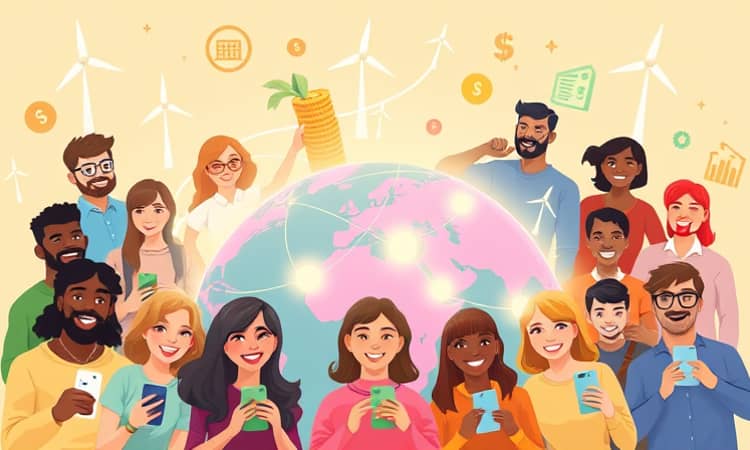
In today's rapidly evolving world, the intersection of finance and technology offers unprecedented opportunities to address some of humanity's most pressing challenges. Fintech for Good deploys finance beyond profit to foster a sustainable and inclusive global economy.
This innovative movement integrates social and environmental factors into fintech strategies, accelerating solutions that combat climate change, poverty, and inequality. It leverages technology for financial inclusion by bringing essential banking services to unbanked populations worldwide.
As we progress into 2026, the strides in financial inclusion mark a historic turning point, with digital tools enabling broader access and empowerment. Global Findex 2025 shows four in five adults now hold accounts, driving significant advances in gender equality and digital adoption.
The vision of Fintech for Good is not just about profit but about purpose. It aims to reshape financial systems to prioritize people and the planet over mere monetary gains.
By focusing on ethical principles, this movement inspires hope and action across industries and communities. It challenges traditional finance to evolve and adapt for the greater good.
Defining the Fintech for Good Movement
Fintech for Good, often abbreviated as F4G, is a global initiative that promotes accountability, responsibility, and sustainability in financial services.
It encompasses a wide range of activities, from networking events and hack days to accelerator programs for ventures that prioritize social and environmental impact.
The core idea is to use finance as a powerful tool for delivering environmental, social, and governance benefits. This approach helps build a resilient future in the face of ongoing threats like financial exclusion and human-rights violations.
Ethical foundations are crucial, with transparency and regulatory frameworks balancing innovation with risk. This ensures that fintech innovations contribute positively to society without compromising integrity or safety.
Through collaborative efforts, F4G is setting new standards for what finance can achieve when aligned with humanitarian values.
Key Topics and Ethical Frameworks Driving Change
At the heart of Fintech for Good are several key areas that guide its mission and implementation.
- ESG Integration: Fintech connects to environmental, social, and governance factors by promoting environmentally friendly choices and clean-energy lending.
- Sustainable Finance Pillars: This embraces responsible investing and impact finance, with investor capital increasingly supporting these efforts in 2024 and beyond.
- Deloitte's Five Ways to Innovate: These strategies include developing taxonomies for social needs and leveraging technology to disrupt profitability-impact trade-offs.
Advanced technologies like AI and blockchain are harnessed for positive impacts, attracting investors for scalable and ethical profitability.
Context-specific technologies focus on underserved populations, such as bottom-of-pyramid services in emerging economies. This targeted approach maximizes social benefits while fostering economic growth.
By grounding actions in ethical principles, F4G builds trust and encourages widespread adoption of sustainable financial practices.
Global Advances in Financial Inclusion and Statistics
The progress in financial inclusion over recent years has been remarkable, with technology playing a pivotal role in expanding access.
- Global Findex 2025: Reports that 80% of adults worldwide now have accounts, with historic gains in gender equality and mobile ownership.
- Funding Shifts: In 2025, a dramatic reordering occurred with USAID ending and bilateral donors reducing commitments, pushing the ecosystem towards new models like university centers and mission startups.
- IMF Insights: Financial inclusion complements credit booms but can predict distress when combined; however, rapid credit inclusion alone is rarely unstable and enhances policymaker early warnings.
Consumer spending in 2025 showed disparity, with lower-income households growing at 0.3% YoY versus 2.2% for higher-income. The 2026 forecast predicts a baseline of 1.4% aggregate real spending growth.
The focus is now shifting from mere access to financial health, resilience, and economic participation. Deliberate protection is essential for last-mile markets to ensure no one is left behind in this digital transformation.
This evolution highlights the need for continuous innovation and support to sustain and build upon these gains.
Pioneering Companies Making a Tangible Difference
Several companies exemplify the Fintech for Good movement, demonstrating how technology can drive meaningful social impact on a global scale.
Other fintech examples, such as PayPal for payments and Robinhood for investing, show broader trends, but F4G companies specifically target ethical and sustainable goals.
These ventures prove that profitability and impact can coexist, inspiring more organizations to adopt similar models. They serve as beacons of innovation in a rapidly changing financial landscape.
By showcasing real-world successes, they encourage investment and participation in the Fintech for Good ecosystem.
Recent Developments and Future Initiatives
Events and initiatives in 2026 highlight the ongoing commitment to advancing financial inclusion and ethical innovation.
- Federal Reserve Bank of New York Event: Held in January 2026, it focused on "An Economy That Works for All," with sessions on financial inclusion, literacy, and innovation for household health.
- Expert Views: Leaders like Brian Harkin from Bayes Business School see huge upside for planetary improvement through ethical fintech, emphasizing its potential for global betterment.
The sector is maturing with distributed support architectures and strong public-private ties. Optimism is fueled by infrastructure advancements and policy focuses on health and resilience.
This momentum is driving new collaborations and accelerating the adoption of sustainable practices across financial services. It signals a shift towards more holistic and inclusive economic systems.
As these initiatives grow, they pave the way for more scalable and impactful solutions in the years to come.
Navigating Risks and Embracing Opportunities
While Fintech for Good offers immense potential, it also faces challenges that must be addressed to ensure sustainable and equitable growth.
- Risks: Funding shocks can disrupt innovation and consumer protection; small markets might be neglected without deliberate efforts; credit inclusion combined with booms can heighten stability risks.
- Opportunities: The scalability of technology combined with profitability attracts investment; trends like AI and data analytics are reshaping finance; affluent investors are increasingly open to reallocating funds towards sustainable options.
In 2026, for example, 41% of affluent investors in Singapore are open to reallocating funds amid falling interest rates. This indicates a growing appetite for investments that align with personal and planetary values.
The future outlook is bright, with F4G poised to become the standard for interconnected and sustainable financial services. By leveraging advanced technologies responsibly, we can mitigate risks and maximize benefits.
Proactive measures and ethical guidelines will be key to navigating this dynamic landscape and ensuring long-term success.
Conclusion: Building a Sustainable Financial Future Together
Fintech for Good is more than a passing trend; it is a necessary evolution in finance that addresses the urgent needs of our time. Through ethical practices and innovative technologies, it paves the way for a more inclusive and sustainable world.
As individuals, businesses, and policymakers, we can support this movement by choosing financial products that prioritize social and environmental impact. Education and awareness are crucial in driving this shift towards responsible finance.
- Action Steps: Advocate for transparent regulations, invest in F4G ventures, and promote financial literacy to empower communities.
- Long-Term Vision: Aim for a global financial system where technology serves everyone equitably, fostering resilience and prosperity for generations to come.
Together, we can harness the power of fintech to create lasting positive change, turning challenges into opportunities for growth and unity. The journey towards a better financial future starts with each conscious choice we make today.